To localize an Android app with POEditor, import your .xml file into a project, translate it using any of the available options and export a localized strings.xml for each language, manually or automatically through Git. Here's how to set it up.
1. Create a localization project
Log in to your account, create a new translation project and add your app's default language to it.

2. Import your Android XML file
In the project page, click Import to upload your keys and source strings from your XML file. Choose Also import translations to a language and select your app's source language.
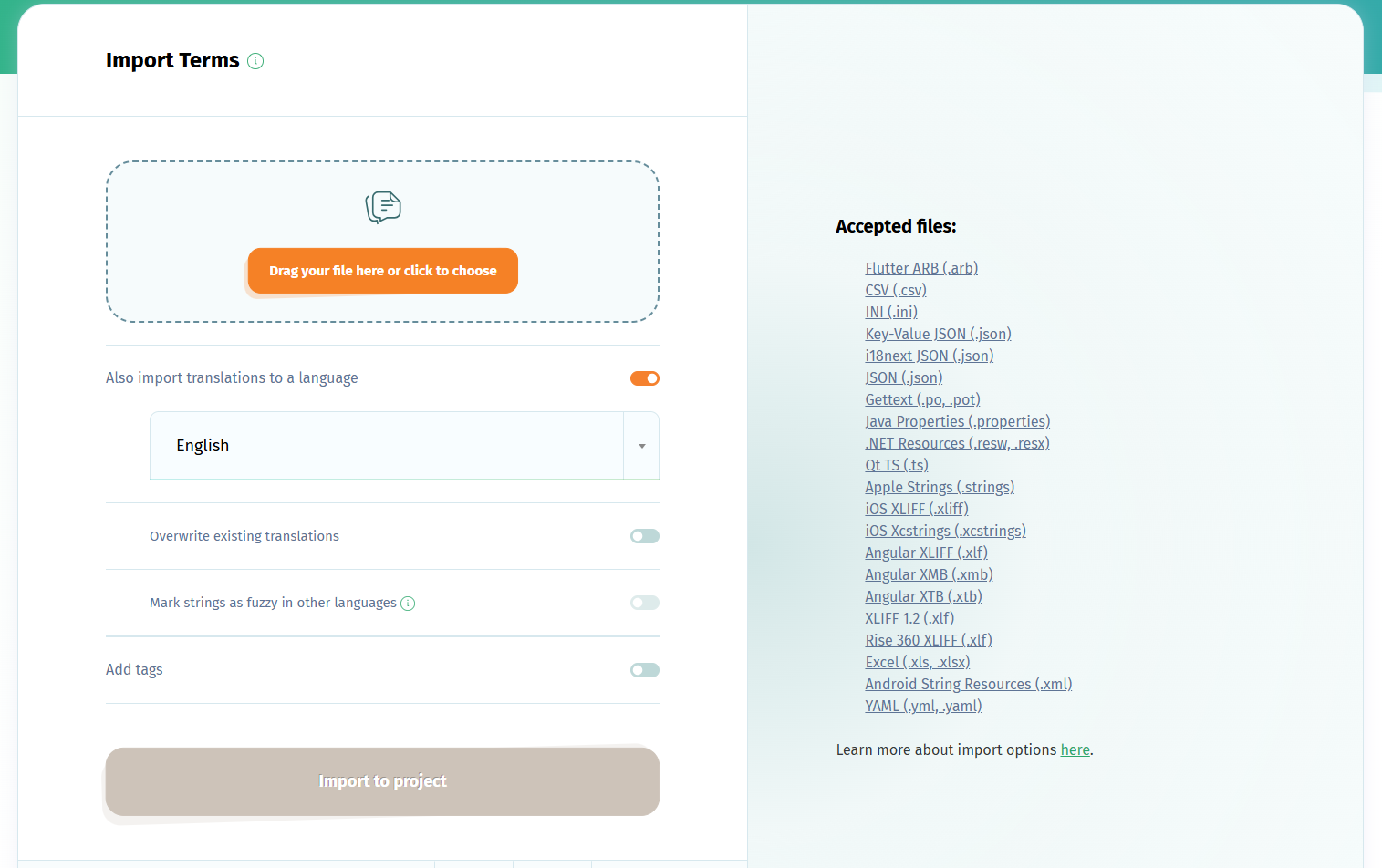
This language will automatically be set as your project's Default Reference Language (which you can change in the project's Settings).
3.Translate your app
Add the languages you want, then choose how to translate them:
- AI translation with your own OpenAI, Claude, Gemini, Azure AI or Amazon Bedrock account. You can customize the prompt to match your tone.
- Machine translation with Google Translate, DeepL or Azure AI Translator.
- Your own translators, invited as contributors to specific languages.
- Human translations, ordered from the available LSPs.
4. Export the localized file
When you are done with the localization, you can download each language with Export in its translation page.
You can automate the import and the export too: see step 5.
5. Automate the workflow
The steps above are the manual flow. Once it works for you, you can automate each part of it:
- Sync with your repository. Connect GitHub, GitLab, Bitbucket or Azure DevOps and link each language in the project to its strings.xml file in the repository, for example values/strings.xml for the source language and values-fr/strings.xml for French. You can then import new strings and export translations from the integration page, with import and export rules: for example, tag the strings by file, or export only translated strings.
- Trigger the import and export with webhooks. The integration page has a webhook generator. Add an import webhook to your repository so new strings reach POEditor when you push, and call export webhooks from your build or release scripts to bring the translations back. See how to use webhooks with POEditor and GitHub.
- Run the process on autopilot with workflows. Workflows chain steps such as Git import, AI translation, QA checks, notifications and Git export, and run them manually, on a schedule or on events such as new terms or a completed language.
- Merge translations with one pull request. Export the translations to a branch dedicated to localization, then use a pull request preset to merge them into your main branch, instead of many separate commits.
- Use the API and callbacks. With the POEditor API, your own scripts can upload strings and download the translated files. Callbacks notify your server when a language is completed or proofread, so your script knows when to export.
Ship the translated strings.xml files with your app instead of loading them from the API at runtime: API calls are slower than local files and rate-limited, so they don't scale with your user base. If you update translations between releases, host the files on your own server or a CDN, and keep a fallback in the app. Why reading language files from an API is risky.
Git integrations are available starting with the Start plan, workflows starting with the Plus plan, and webhooks, callbacks and pull request presets starting with the Premium plan. See pricing.
For more tips, see best practices to sync translated strings with your repos.
6. Android specifics
- Plurals: strings defined with
<plurals>are imported with their plural form, and translators see one tab for each plural form of the target language. - Non-translatable strings: you can import strings marked as non-translatable and keep them out of translation.
- Quotes and apostrophes: see quotes in Android string resources to avoid broken builds.
Also building for iOS? See how to translate iOS and Android apps in the same project. Only need to edit a strings.xml file? Use the Android XML Editor.