 Alexandra
One platform
Centralized translation, review & memory.
Automated workflows
Trigger-based chains replace manual handoffs.
AI + human
LLM drafts, proofreaders finalize.
Continuous sync
Azure DevOps + webhooks keep strings aligned.
SD Worx is a leading provider of HR and payroll services, supporting ~90,000 organizations to manage their workforce efficiently and legally across more than 120 countries. Since 1945, the company has offered HR solutions covering the full employee lifecycle, from payroll processing and workforce administration to broader human capital management — making enterprise localization a critical part of how it serves global clients.
At their core, SD Worx’s services are designed to ensure accuracy, compliance with local regulations, and operational efficiency, especially for organizations active across multiple countries. Given its highly global environment and the diversity of teams, systems, and markets it engages with, managing multilingual content at enterprise scale is a complex challenge. Ensuring consistency and accuracy across languages is therefore a key pillar of its operational excellence objectives.
The challenge: managing enterprise localization complexity in a multilingual setting
Before starting their journey with POEditor, the team at SD Worx faced several challenges typical of enterprise localization programs. Maintaining a clear overview of all translations while keeping processes such as review and the actual translation of strings centralized within a single localization management platform was one of the must-haves they mentioned. Furthermore, having a translation memory available across projects was a prerequisite for any enterprise-grade solution.
In terms of what they expected from a translation management system built for enterprise localization, the team aimed for:
- gaining a better overview of the translated content
- including a review step in their workflow
- bringing a layer of automation to their localization process
Our platform met their requirements and stood out during the evaluation process. The possibility to generate AI translations directly in POEditor, combined with the option to assign proofreaders to their projects, created the collaborative workflow they were looking for. In addition, having a translation memory available across multiple projects laid the foundation for improving consistency over time (a core requirement for any large-scale localization program).
The solution: a centralized, automated enterprise localization platform
With POEditor in place, the team introduced new ways of managing their content and making localization faster and easier: integrating LLMs into their translation process and building automated workflows (a feature they use extensively). These workflows allow them to set up chains of processes that run automatically with different triggers and levels of customization, reducing the manual effort that typically burdens enterprise localization teams.
Another way of reducing manual work is the integration with code hosting services. In their case, the Azure DevOps integration, combined with webhooks and pull requests, enables continuous synchronization of strings, ensuring that translations remain aligned with product updates.
To maintain consistent terminology across all translations, SD Worx uses glossaries, which help them represent HR and payroll concepts accurately and uniformly in every language. At the same time, the translation memory feature allows them to reuse previously made translations, significantly reducing duplication and improving speed and coherence across their enterprise localization workflow.
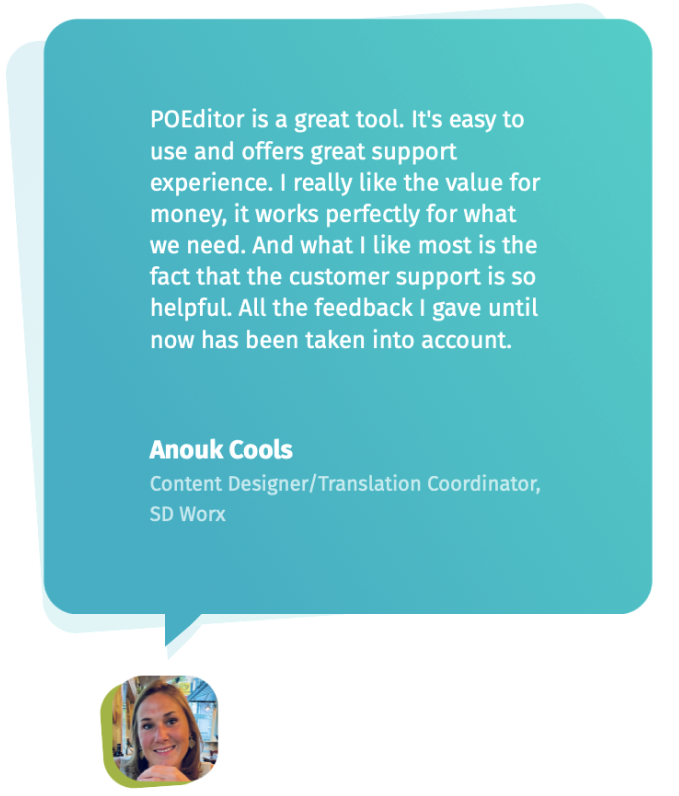
Beyond the product itself, the team pointed to POEditor’s support as a standout — their feedback has shaped many of the improvements rolled out over time:
Conclusion: scalable enterprise localization with POEditor
SD Worx found a reliable enterprise localization partner in POEditor, transitioning from fragmented workflows to a centralized and scalable translation management system. By bringing translation processes into a single platform, the company significantly improved clarity and coordination across teams.
The addition of automation and AI-generated translations has further streamlined operations, while features such as translation memory and glossaries have contributed to greater consistency across languages. Together, these improvements position SD Worx to handle growing multilingual demands (and the complexity of global enterprise localization) with greater confidence and flexibility.