 Mirela
Research shows that language affects purchasing decisions, trust, customer satisfaction, and brand loyalty. If your customers understand it, they’re more likely to buy. It’s that simple. Let’s see exactly what’s the impact of localization on sales, looking at the data and real-world examples.
Let’s look at the data
A CSA Research survey of over 8,000 consumers across 29 countries found that:
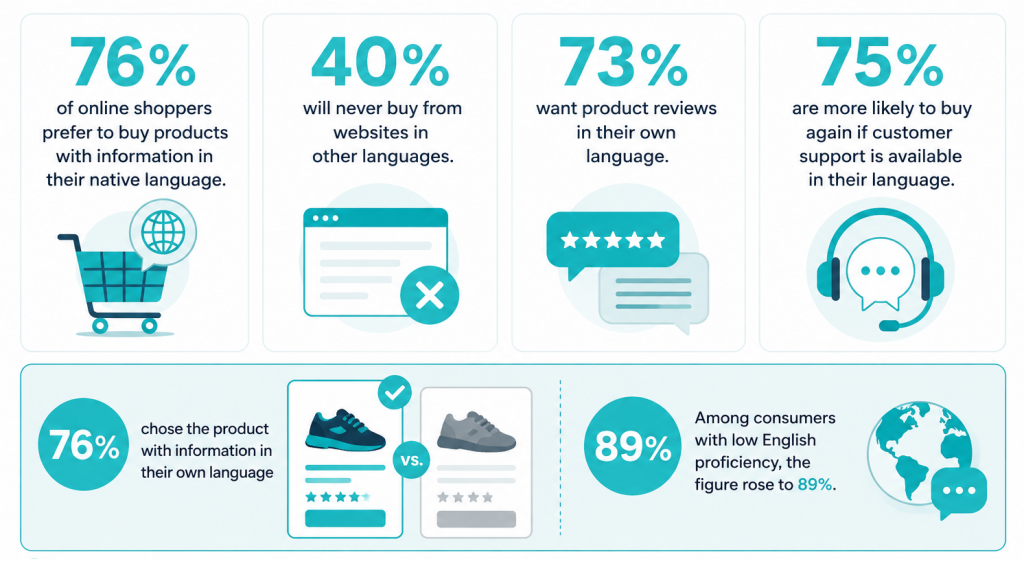
So yes, many shoppers will choose a cheaper product if given the option, but it’s clear that language remains a major purchase factor. Even Shopify’s documentation highlights that customers are more likely to purchase when the regional expectations are reflected in the buying experience, when prices are displayed in local currency, and when content is available in their preferred language
How localization impacts sales
Localization is so powerful that it can reduce the barriers between a customer and a purchase.
Access to new markets
Localization opens the door to more customers. Although English is widely used online, many internet users still prefer consuming information and making purchases in their native languages. Through localization, you can expand beyond your local market and compete more effectively in other regions. More customers, more sales.
Simplifying the buying process
Every obstacle in the purchasing journey lowers the likelihood of conversion. Language barrier is such an obstacle. It creates friction at multiple stages of the customer journey. When you have a potential customer who struggles to understand the product details, they may abandon the purchase before reaching checkout.
Even when these customers are willing to proceed, the uncertainty about shipping costs, payment options, taxes, or return procedures makes them postpone or cancel the transaction.
With the help of localization, it’s possible to simplify the sales process because you’d be adapting the content, terminology, currencies, date formats, measurements, and payment methods to the local expectations. Making purchasing easier has a direct impact on conversion rates because your customers can move from product discovery to purchase.
More trust and credibility
Purchasing online always involves some sort of risk. Customers must trust that a product will meet their expectations, that payment information will be secure, and that any issues can be resolved after the sale. When the content is shown in a foreign language, people tend to worry more. On the other hand, when the product descriptions, reviews, support information, and checkout pages are presented in a customer’s native language, they begin trusting.
Better product understanding
Customers are more likely to purchase when they understand what they’re buying. Many types of products and services are dependent on accurate communication. There’s no room for misunderstandings. Localization is a way to ensure that the product features, benefits, and use cases are communicated in ways that resonate with local audiences. As a result, your customers gain a clearer understanding of the product’s value, and are thus more likely to go through with the purchase.
Better customer experience and retention
Any company wants to see their customers coming back. Localization influences repeat purchases. If you make sure your customers receive support, documentation, onboarding materials, and communications in their preferred language generally, they’ll be more satisfied. And what does that mean? They’re more likely to buy again.
Competitive advantage
Localization can be that thing that sets you apart, especially in crowded markets. Let’s say you and a competitor have products that are rather similar. Who will the customers choose? It’s likely they’ll choose the option that feels more familiar, accessible, and trustworthy. A localized website, localized customer support, and region-specific purchasing experience can provide a decisive advantage over competitors that offer only a generic global experience.
Final thoughts
The evidence is clear: localization has a measurable impact on sales. It’s clear that language does influence buying decisions, with the majority of consumers favoring localized experiences. Do you want higher conversion rates, stronger retention, and increased revenue? Maybe try localization. In a marketplace where customers have countless alternatives, try speaking you costumer’s language.